Season 1 | Episode 1
Transcript
Daniel (Host):
Welcome to rough seas, the Marine Engineering Podcast where industry leaders guide us through the perilous, tumultuous, and sometimes pure crazy times of a career at sea. On this week’s episode, Ben speaks with Justin Manley, a forward-thinking engineer and executive with extensive experience across industry, academia, and the public sector.
He is widely recognized as a leader in the development and operation of uncrewed systems. Following his tenure at MIT and his support for the National Oceanic and Atmospheric Administration, Mr. Manley established Just Innovation Inc. His consultancy focuses on providing strategic solutions to clients, particularly in the areas of uncrewed and undersea systems, robotics, and sensors.
In this interview, we dive deep into the ocean tech landscape, what is currently driving innovation in the space, and how it can best be financed. His humble demeanor resonates through his commitment to climate innovation and entrepreneurship, best characterized by his mantra, profit, and planet.
Ben Garvey:
You have a Master of Engineering in Ocean Tech from MIT, and you’ve worked obviously very deeply in the industry with the technology, and yet you’ve done this natural shift to entrepreneurial work, to sales, to executive leadership, to consulting. Tell me a little bit about how that felt as an engineer, as a technical person. I mean, are you torn between diving in and just putting the blinders on and doing programming and playing with the tech versus looking at the bigger picture?
Justin Manley:
Yeah, great question. An interesting nuance of my career is that by nature, when I was at MIT, one of the early ocean robotics companies called Bluefin Robotics was spinning out of the lab I was in. What happened is the professional staff of the lab all left and joined the company at about the same time I was finishing my graduate work. My thesis advisor, who happened to be the department head and the head of the lab, basically said to me, in not so many words, “You’ve been paying tuition to work in the lab. I’ve got a whole bunch of staff jobs that have opened. How would you like to become the operations manager of this lab, and I’ll pay you?” So that’s how I got involved.
As a consequence, over the four years I had that paid role, we built the team. We ended up with about six staff, and I became management very quickly. There was plenty of technical management and design work, but I never wrote code again. I never had the chance to sit down and do design work in CAD again. Though, I think for me, it was fortunate that I didn’t miss it. I loved that we were building robots and searching for shipwrecks. It was just exciting.
When you’re sitting in a lab at MIT, even if you’re not the person doing the design work, you’re still feeling technically challenged. I love working with engineers. I can engage with engineers, and I sort of understand product development, control theory. Even this year, I mentored a startup that was having some challenges with certain technologies. I knew enough to ask the right questions and help them solve their problems. So I’m very happy with that balance. I know how things work, at least in areas I have expertise, and that helps me with the bigger picture stuff.
Ben Garvey:
That’s fascinating. I can feel that, and I can see that in my own career progression too. It’s interesting. I still savor those moments when you step into a technical challenge and provide a solution. There’s still a good feeling there, even though it happens less frequently.
There’s an interesting crossover with Bluefin Robotics in my own history. My first job as a contract designer was to develop a launch retrieval system for the Bluefin 21-foot AUV that the Monterey Bay Aquarium Institute was using. It was a cool little project, and I got to know the Bluefin systems well. Ocean tech days today are obviously different from ten years ago. The challenges have changed. What do you think has changed in ocean tech in the last 10 to 20 years, and what are the big challenges today?
Justin Manley:
I’ll caveat my perspective. These days, my time is spent between working with a small U.S. company on Navy and Department of Energy projects, being a venture partner in an impact fund focused on climate and ocean innovation, and working with a philanthropy that deploys money to advance technologies aimed at improving ocean health or conservation. So, I’m shaped by that cross-section.
From a tech perspective, the barriers to entry for innovators and entrepreneurs are coming down. We now have uncrewed vehicles that cost $100,000, a fraction of what they used to. These tools are becoming more scalable and accessible, which means they are easier to produce and use.
A good example of this is the U.S. Navy, which is developing USVs for surveillance. These are expensive boats operated by highly trained personnel, but scalable and accessible robotics are making this capability available to smaller nations with fewer resources. This trend excites me the most.
Demand signals are also evolving. For example, the 30 by 30 initiative aims to protect 30% of the ocean by 2030, up from 6% today. That’s a fivefold increase, but budgets aren’t likely to increase fivefold. This creates a demand for innovative, affordable solutions. Another example is offshore energy. A single oil rig might generate as much energy as 1,000 wind turbines. But the budget for maintenance and monitoring isn’t going to increase proportionately, so we need to do things differently.
Ocean tech is becoming more affordable, but also more capable. Technologies like cell phone advancements and software innovations are helping drive this transformation.
Ben Garvey:
Right, and I wanted to touch on that. What are the enabling technologies? You’ve talked about military and energy drivers, but what’s enabling the response to this demand?
Justin Manley:
Yeah, so the fundamental physics of water and networking remain a challenge. Acoustics will only do so much, and I don’t anticipate breakthroughs in physics, but we are seeing innovations in connectivity, such as Starlink providing proper internet on the ocean’s surface and CubeSats offering satellite networks. These technologies weren’t developed specifically for the ocean, but we’re benefiting from them.
On the sensing front, inspired by biomedical industries, we’re moving toward solid-state sensors, which are more reliable than wet chemistry sensors. Optical sensors are also making strides, which is exciting. These tools may not always be as accurate as traditional instruments, but because they are cheap and ubiquitous, we can transition from data scarcity to data abundance.
In platform development, we’re benefiting immensely from smartphone technology. Ocean robots are now using smartphone processors and cameras, making them affordable. The investment in autonomous cars has pushed processor technology, which also benefits ocean robots. Add to that the advantages of 3D printing, cheaper solar panels, and innovations from recreational boating, and we have the perfect storm of advancements making ocean tech more affordable and accessible.
Ben Garvey:
That’s exciting. Do you think we’ll reach the point where sensor costs decrease dramatically, and we see a massive increase in their deployment?
Justin Manley:
I think we’re on the right track, but business models are still evolving. For instance, we might see sensors drop in cost by three to four orders of magnitude and platforms improve by one to two orders of magnitude in efficiency. But demand signals will drive that. For example, if you’re monitoring marine protected areas or doing carbon monitoring, a new market could emerge where platforms deployed for one purpose can also serve other monitoring roles. We need to experiment with business models to make this work.
Ben Garvey:
That’s fascinating. Is there significant investment in ocean tech, similar to the early internet days in Silicon Valley?
Justin Manley:
Yes, we’re seeing significant investment in ocean technology, but it’s fragmented. There are funds focused on ocean climate issues, others on broader ocean innovation, and even some restricted to specific regions. Defence is also a huge driver, and there’s significant money flowing into defence-focused ocean tech companies.
However, the ocean industry has a longer product development and sales cycle than other industries. It takes time to develop prototypes and find customers, so investors and entrepreneurs need to have realistic expectations. We might see longer lifecycle funds and even different types of capital, like private equity or debt finance, tailored to the ocean tech industry.
Ben Garvey:
That’s great insight. So, what gets you excited and motivated every day?
Justin Manley:
I’m a techno-optimist and a capitalist, and I believe in the power of technology and markets. I see acceleration, innovation, and growth in both. When you layer on the focus on ocean health and conservation, it’s a really exciting time to be in the field. I spend my days talking about making money, innovating technology, and making the ocean healthier—all of which are incredibly motivating.
Ben Garvey:
That’s fantastic. Thank you so much for your time, Justin. It’s been a fascinating discussion.
Daniel (Host):
This episode was produced by me, Daniel, at Enginuity Studios. If you have a story to tell about life within the marine sector or have an engineering challenge you want to share with one of our experts, please reach out to info@enginuityinc.ca. To learn how you can overcome your organization’s harsh environment challenges, visit our website at enginuityinc.ca. We’d love to hear from you. Until next time, fair winds and following seas.
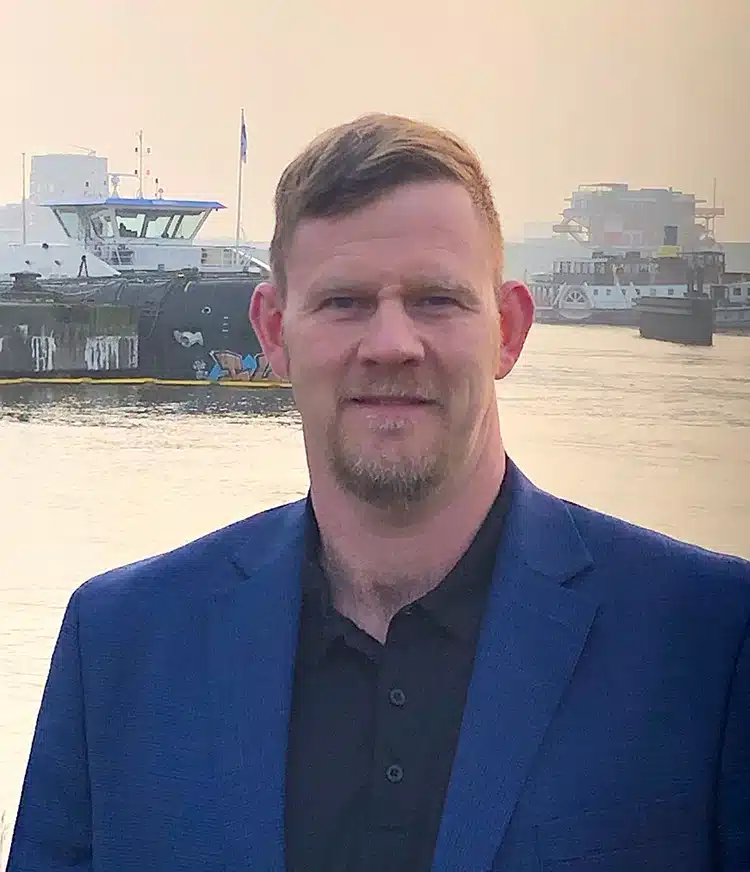
Justin Manley
Virtual CxO - Technologist, Executive, Advisor in Oceantech and Robotics
Justin Manley is an innovative technologist and executive with experience in startup, public corporation, academic, and public sectors. Mr. Manley is a recognized leader in uncrewed systems development and operations. After professional roles at MIT, supporting NOAA and in the private sector he founded Just Innovation Inc. in mid-2015 where he supports a variety of clients with a focus on uncrewed and undersea systems.
Mr. Manley has demonstrated accomplishments in professional organizations including MTS and IEEE. He is dedicated to innovation, advising startup companies and as judge for the ANA AVATAR XPRIZE.

Greenlight Analytical’s Breakthrough in Cannabis Product Development and Analysis
Greenlight Analytical eliminates the guesswork from indoor agriculture and cannabis production by providing real-time information needed to adjust the growing environment and inputs. Their easy-to-use, accurate cannabis analyzer, the HarvestIQ, measures the chemical profile of plants as they grow.

Prototyping and Product Development with Start-up Prosaris
Prosaris is a leading provider of ultrasonic leak detection solutions, offering advanced detectors and a comprehensive leak management platform. Their mission is to combat energy waste caused by compressed air leaks, providing cost-effective and efficient solutions to optimize systems, reduce energy waste, and improve operational efficiency.

Remote Product Development Revolutionizes Electronic Gaming Tables for Jackpot Digital
Jackpot Digital Inc. is a leader in the development of electronic gaming tables and mobile gaming platforms for the cruise ship and regulated casino markets. With over a decade of industry experience, the company specializes in multi-player digital and casino gaming products, including state-of-the-art electronic poker and casino game tables.

Next-Gen Defense Product Design & Development for Realistic Hoist Training Experiences
Based in Nova Scotia, Canada, Bluedrop Training & Simulation Inc. is a leading provider of advanced training solutions tailored for the aerospace and defense sectors. The company specializes in the development of interactive courseware and state-of-the-art virtual and augmented reality training systems.