Scaling Up FreshrPack from Lab to Pilot Production
INDUSTRY:
Industry 4.0, Smart Manufacturing
TYPE OF WORK:
Pilot Line Design, Process Development
About the Client
Freshr Sustainable Technologies inc.
Freshr developed a film with a microgel coating designed to extend the shelf life of fresh protein from roughly two to four days. The coated film can be used by multiple stakeholders across the supply chain to ship fresh fish (and other protein) further, ship cheaper, and waste less.
Freshr’s early work proved the science using small batch coupons; letter-sized sheets were coated by hand, cut into one-inch squares, treated with liquids, rinsed, dried, and then validated for performance. This batch approach validated efficacy, but there was a need to examine how fish processors and vessels would use the material at scale.
Understanding the Problem
The Challenge
Freshr’s core challenge was to scale from tiny batches to continuous rolls that could be supplied to processing plants that package fresh proteins without losing process control or adding excessive cost and complexity. They needed:
- A continuous, reel-to-reel coating and treatment process that maintained the functional coating only on the active surface and respected when and where the fragile film could be contacted.
- A realistic system footprint that fit into a constrained facility area, initially a ~24-foot space being renovated for this purpose.
- Clear capital and operating cost expectations to support funding applications and internal decision-making; including understanding when industrial-grade equipment made sense versus custom or simplified solutions.
At the start, scaling the lab recipe linearly created seemingly impossible requirements, such as considerable water usage and large volumes of acidic solutions, which had knock-on implications for storage, logistics, and safety. Freshr needed to know whether their process was manufacturable, at what scale, and at what cost, and what would have to change in the chemistry, sequence, or equipment to make it viable.
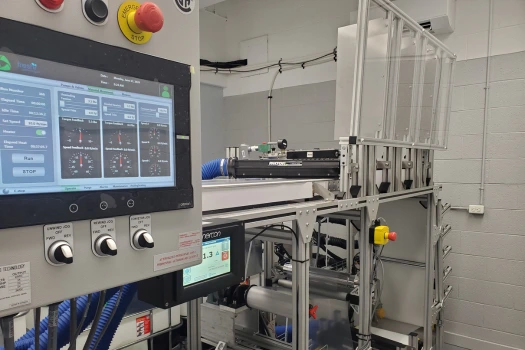
Pilot Line Installed at Freshr Facility
Pilot-scale system deployed on-site at Freshr facility, awaiting Site Acceptance Testing (SAT)
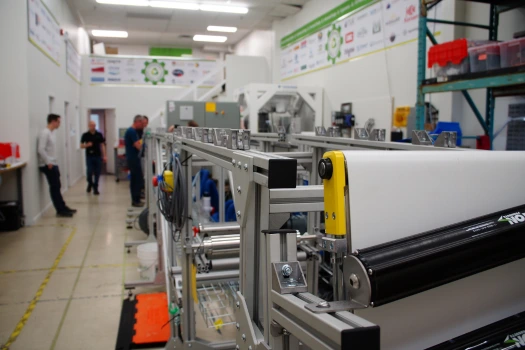
Final Assembly on Enginuity Automation Floor
Assembly team completing critical integration steps prior to Factory Acceptance Testing (FAT)
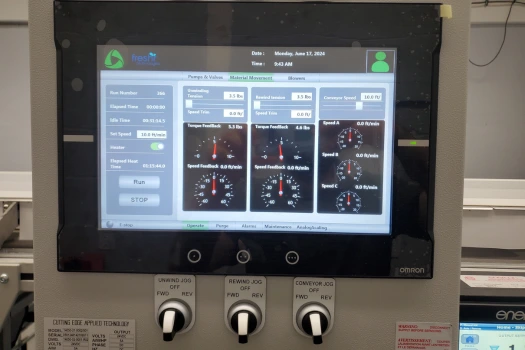
Operator Interface Designed
Custom-built HMI providing real-time monitoring and control across the system
Solving the Challenge
The Solution
Discovery: From Lab Steps to Industrial Process
Enginuity’s first engagement was a process discovery to translate Freshr’s stepwise lab recipe into an equivalent industrial sequence. The team:
- Mapped every lab step (coating, waits, heat, rinses, immersions) and identified likely industrial analogues such as spray systems, baths, drying stages, and reel handling hardware.
- Analyzed facility constraints and sketched linear reel-to-reel layouts showing unwinding, coating, treatment, rinsing, drying, and rewinding within the available floor space.
- Estimated cost for straightforward industrial grade approach, using off-the-shelf unwinder/rewinder systems, multichannel precision spray systems, and full automation and safety.
This discovery confirmed that a continuous process was technically feasible but would carry a significant cost once integration, custom work, and commissioning were included. It also highlighted that many early assumptions (e.g., simple linear scaling of liquid volumes) would make the plant operationally unwieldy or uneconomic if left unchallenged.
Concept Design: De-Risking and Right Sizing
Freshr and Enginuity found a way to reach a realistic pilot line within budget. The conceptual design phase focused on de-risking and “right-sizing” the solution:
- Manifolds and misting nozzles similar to those used in grocery produce misting, provided controllable spray coverage.
- A manual process of cutting samples out of the moving film using simple tools, avoided an entire subsystem and associated costs.
- Safety and automation were tuned to the actual phase of the project; this machine was re-framed as an R&D tool and first continuous prototype, not a fully automated factory line, so extensive light curtain networks and other high-end production safeguards could be scaled back and introduced at an appropriate time.
Enginuity also tackled the scaling risks with targeted physical tests. When linear scaling suggested the need for a six gallon/minute nozzle, they sourced such a nozzle, hooked it up, and demonstrated the firehose-like flow and forces to the client in the carpark.
This tangible test helped Freshr revisit process chemistry and methods (e.g., moving from immersion baths to sprays) and reduce liquid consumption and handling complexity to more achievable levels.
Physical Constraints and Layout Evolution
As layouts evolved, Enginuity developed configurations that were adaptable to various room constraints. At the end of conceptual design, Enginuity provided a 3D representation showing equipment “floating in space”: reel handling, spray and treatment zones, and other modules positioned approximately where they would go, but without final mounting details. This conceptual model served as a communication tool for Freshr’s internal stakeholders and also as visual evidence in funding applications.
Summarizing the Outcome
The Conclusion
This case illustrates how an innovation in materials science requires thoughtful innovation in manufacturing and process design to become commercially credible. The value Enginuity provided went beyond mechanical engineering – it included process re-thinking, scale-up validation, visual communication for funders, and pragmatic budget management.
The system retained the core characteristics established in conceptual design; a reel-to-reel, continuous R&D tool that unrolls, treats, and rewinds the FreshrPack® Microgel Technology.
The conceptual design visuals and the existence of a defined, buildable system strengthened Freshr’s position with stakeholders by demonstrating that the path to real world trials and eventual production had been de-risked from a technical standpoint.
Most importantly, moving from one-inch coupons to continuous rolls positioned Freshr to supply trial scale reels to fish producers, enabling multi-month in-process testing that simply is not possible with small lab coupons.
Key Takeaways

Bridge the Gap
An intermediate R&D line sits between lab and factory.
Right-Size Early