How Larch Wood Increased Production Output Without Losing Its Roots

Manufacturing
TYPE OF WORK:
Process and Constraint Analysis
About the Client
Larch Wood
What do Pamela Anderson and many Michelin-star restaurants have in common? Well, if you said they both use Larch Wood Cutting boards – you’d be right.
With increasing demand and a modest workforce, CEO Liam O’Rourke was determined not to let the company fall victim to its own success. With a strong niche brand but an aging workforce, the factory had maxed out at about 9,000 boards per year. Demand, however, was much higher than capacity, and Liam needed to scale the business while mitigating the inherent risks to the business and its employees.
Liam, experienced in the social enterprise sphere, brought patience and a “systems mindset” to the burgeoning company. Partnering with founding employee Wayne, who had deeply ingrained woodworking knowledge, the two set out to turn a rural craft operation into a more modern, scalable factory while preserving product quality and their community roots.
Understanding the Problem
The Challenge
With demand drastically exceeding capacity, the default response had become turning customers away, as 9,000 boards had seemed like the maximum output for the factory. The plant layout had inherent bottlenecks, especially at the sanding station, which is the most labour-intensive step.
Furthermore, aging equipment meant breakdowns and variability, all on top of a change-weary, older workforce cautious about disruption. These factors compounded the challenge of increasing production from 600 to 1,000 boards per month.
As with any operational improvement, the leadership challenge was to increase throughput and modernize the operation without shutting down production or eroding trust, and to do so with realistic capital spend. Larch Wood also needed better data and planning capabilities to manage global market volatility, particularly in key export regions, and to address material-handling and waste issues such as sawdust and boiler design.
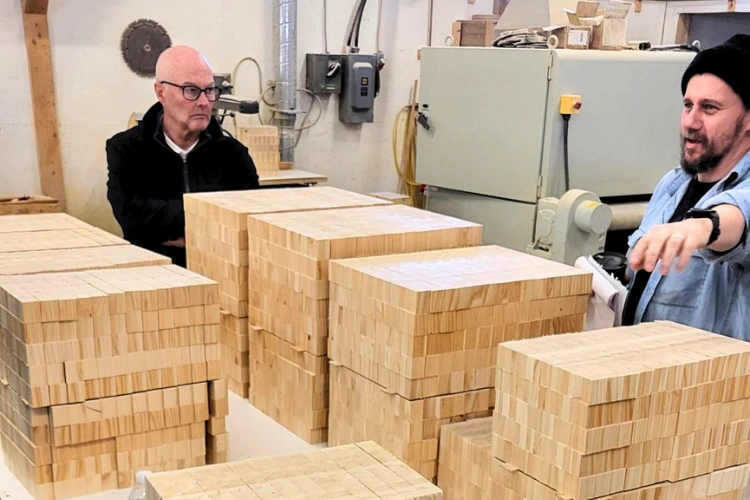
Larch blocks matched and ready for glue-up
Stacks of wood block lined up for glueing with correct grain orientation.
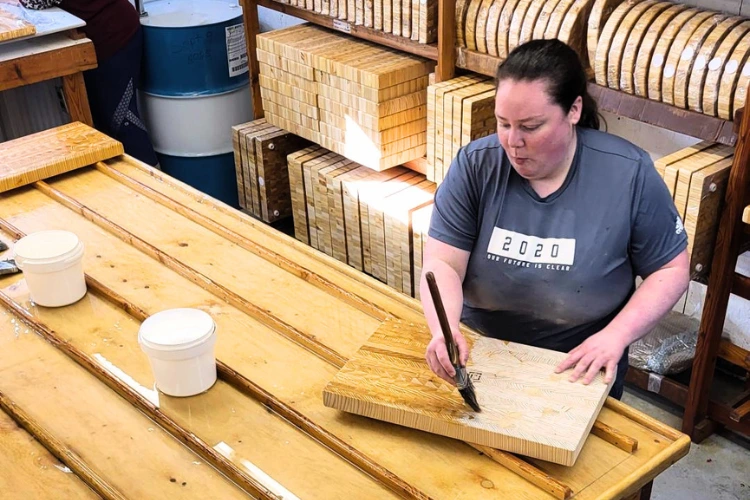
Applying an oil and subsequently oil and beeswax finish
As the boards near completion, a sealing oil is applied.
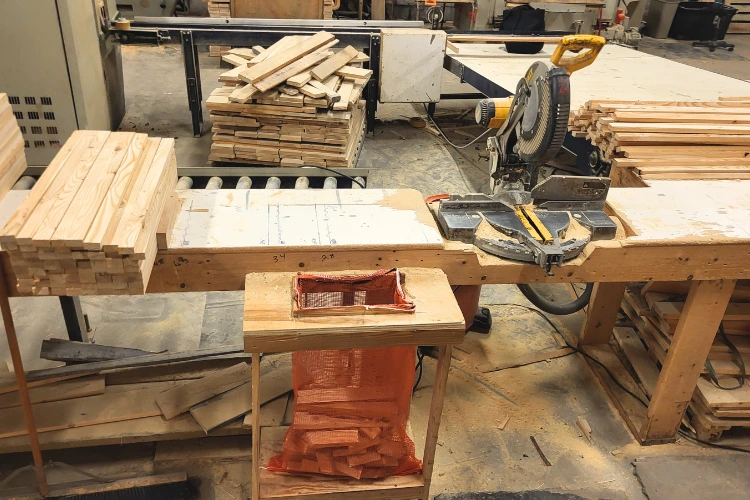
Offcuts are bagged and sold as kindling.
A byproduct of the production process offers secondary product, adding value and eliminating wastage.
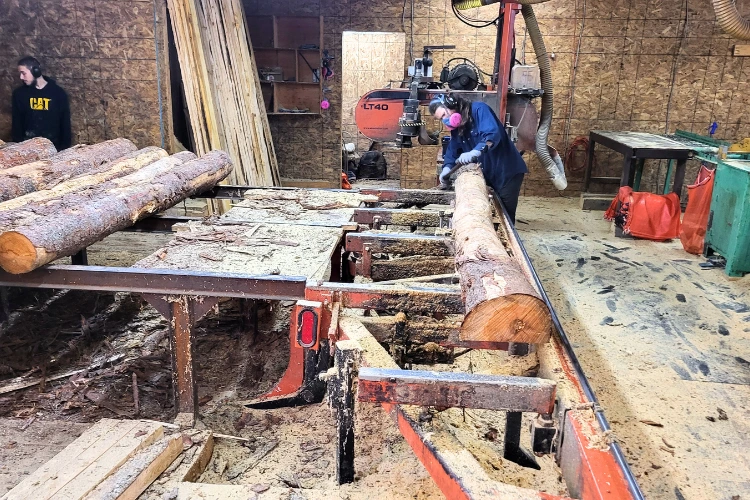
The local larch wood logs, are sawed
By having their own mill, Larch Wood is able to control the quality of raw product and keeps the supply chain within the region.
Solving the Challenge
The Solution
Liam started with people and credibility. He worked every station in the factory and used regular, face‑to‑face, all‑hands sessions and walk‑throughs to explain proposed changes and co‑create solutions with operators. Framing growth in simple shared targets-such as moving from 600 to 1,000 boards/month-turned improvement into a shared mission among the whole team with many practical ideas emerging directly from the shop floor.
Working with Enginuity, the team collected data including WIP (work -in-progress), pace requirements and timing. This data would be essential for a comprehensive current-state VSM (Value Stream Map) resulting in a detailed constrain analysis report. With modest capital on targeted used equipment and Enginuity’s guidance on workflow and throughput, they reduced sanding labour from five full‑time people to three while increasing output, redeploying staff to other value‑adding roles.
Having mapped the existing flow, identified bottlenecks, and sketched future‑state layouts that emphasized a clear, one‑direction material flow Larch Wood then added roughly 8,000 square feet through a mezzanine and re‑oriented major equipment. The team then focused investments on the true constraint: the sanding area.
Throughout a three‑month rebuild, the plant stayed online and even recorded its best quarter ever, demonstrating that a blend of internal leadership, Enginuity’s process expertise, and incremental change could deliver step‑change performance with minimum disruption.
Summarizing the Outcome
The Conclusion
Increasing output is not just simply adding some automation, it is much simpler. By analyzing the constraints within the process, Liam, Enginuity and the Larch Wood team uncovered a smart, systematic approach to increasing throughput. The outcomes of the analysis resulted in reduced labour on the more odious tasks, while reaching the output needed to meet customer demands.
Key Takeaways

Trust, Collaboration, Change
Focus on Constraint